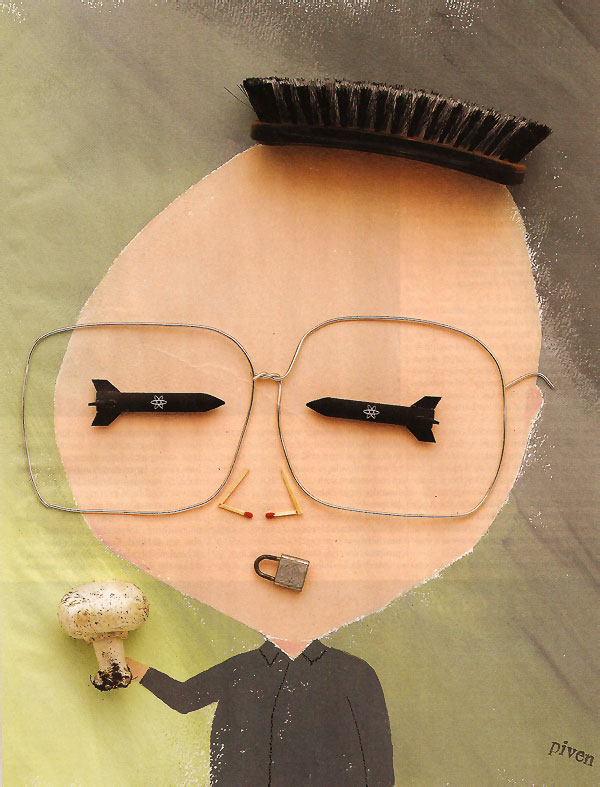
Have you brought a powder keg with you today? You strongly reek of it.
You may be thinking that I am belligerent, but you sound even more so! This is a great start for a conversation about dignity.
I was just teasing, trying to make things a bit lighter.
How can you make things light when you order tiramisù, mille feuille, appelgebak, Sachertorte, and Linzertorte, all at the same time?
In honor of the European Union...
But you have skipped many countries, and Austria is represented twice.
If we think about the House of Hapsburg, what we consider Austrian pastry covers quite a bit of ground.
You are trampling on political, historical and cultural sensibilities!
I was just kidding, you know that.
I can never be sure about you.
You don't trust me?
I was teasing. But, it's true that joking and teasing need trust in order to function as such. We talked about this in connection with stereotypes.
I believe that it is possible to say a friendly joke to a total stranger, though.
The trick is how to build that instant rapport. That does not imply that a short introductory exchange is a sine qua non. It is a matter of how you say it and which facial expression you adopt.
Circumstances, wording, voice, sharpness of the eyes, shrug or lack thereof, smile or lack thereof, laugh or lack thereof...
The good news is that it comes with so many conditional clauses that no self-help book can teach you what is right on all occasions.
Is that good? My suspicion is that some cultures are quite adept at it, while others aren't. I also suspect that what is taken as amicable in one culture is not so in others.
I used to be of that opinion, but lately, I have been thinking that if your intention is good, that shows in spite of cultural differences.
That's quite sweeping and optimistic, especially coming from you.
Do you remember my claim that maturity transcends cultural boundaries?
Hardly. ... Yes, yes, I do! I was just kidding.
That claim implies that teasing can be done artfully with anyone, even across cultures.
I recall that, because faux pas cannot be avoided, maturity is about how to make amends for it. Does that mean we should tell another joke when the first one turns out to be a dud?
In case of jokes that are perceived as offensive and/or tasteless, it is best to offer a sincere apology, I think. My point this time is that your intention gets conveyed most of the time.
I don't understand. You are now saying that teasing and jokes are almost failure proof.
No, my dear comrade, on the contrary. Many of them fail, because the little bits of nastiness almost always manage to manifest themselves.
Perhaps that is the purpose, to dress up a nasty remark and present it as a joke.
If so, you should be prepared for defense. In many problem cases that I witness, the words 'teasing' and 'joke' are used as shields when the nasty core is exposed.
"What are you getting all upset about, it's only a joke." "You have no sense of humor." ... Such lines would not count as proper defense.
If you are going to make someone uncomfortable with a joke, I presume that you are doing so with good reason. You'd better be prepared with another good biting joke to fend off the counterattack. This is another variant of my stance that the proof of maturity is in making amends.
I don't think the last example is exactly making amends, but yes, I understand your point. We have to take responsibility for what we say and that graciously, whenever possible. Getting back to nastiness shining through, do you mean to say that if there is none of it behind, people would sense so across cultural and social fences?
Yes.
In other words, if your intention is filled with affection and nothing else, the teased would understand as such?
It sounds rather simplistic and sugary, but yes, that is what I mean.
I know that you like everything complicated and rugged, so I stated your point on your behalf. And, this is what I get in return...
My tone should have made it clear that I agreed that it was the most efficient way of expressing the idea.
What can I say, I missed that.
It happened because you do not trust me as much as I thought you did. Good intentions have the power to come through, but not all the time. The same happens to bad intentions. That is why manipulation succeeds.
Aren't there variations in sensitivity among us in that sense?
I happen to be particularly fine-scaled in that regard.
Avoiding the expression, 'chips on one's shoulder,' eh?
I was avoiding the word, 'sensitive.' Once in a while, I react negatively to a remark for seemingly no good reason.
Your evil streak comes out.
That used to be my interpretation. But now I think it is because I sense lack of respect, behind the ordinary, or even sweet, words. Sometimes it is plain malice, more than lack of respect.
If it is not dignity, it's respect...
They are related, of course. To honor dignity is to show respect.
Hurray, we are back to dignity!
Some people shower me with praises, but...
Really? Can I meet them? Are they homo sapiens?
If they do not quite mean it, it shows. Some pose as sincere, but in fact, they are condescending.
Why does everything become so twisted when you are involved?
We are under this great misunderstanding that any praise would make anyone happy.
Not to worry. We know that you are an exception.
Many of us have not thought carefully about the premises of praising.
As you may have noticed already, not all of us list thinking hard as a favorite pastime.
Think about it...
I told you, many of us don't. ... Okay, I will keep quiet for a while.
To praise someone assumes that we have the capability to evaluate that person. In addition, by allowing our evaluation be known to its subject, who has not asked for any evaluation by us, we unilaterally declare authority over the evaluated. You wouldn't go up to Albert and say, "Hey, Al, good job, that theory of yours, the general theory of relativity. I thought that was quite nifty. Keep it up."
I can't. He's dead.
...
My knowledge is too limited to fully appreciate its contribution to modern physics, and further to natural science in general, not to speak of the underlying mathematics and its beauty. Hence, I wouldn't.
You see? You would think, "Who am I to tell Al that I think highly of him as if that would make a difference?"
The flip side of that is: if you commend a person, you are assuming that you are someone vis-à-vis her/him.
What if a person who does not have the capability to properly evaluate you gives you praise?
Are you again thinking of unwanted suitors?
I am thinking of a wider group of people, including them.
Most of us are not equipped with adequate knowledge to evaluate a case like yours, unless s/he has dabbled in clinical psychology or psychiatry. Plus, according to what you said earlier, if we have good intentions, shouldn't it come through?
Bravo, my dear comrade! Yes, it does. And, I can tell you that, in too many cases, I see patronizing or self-serving motives.
How does a self-serving motive work?
"I want to make this person feel good so that s/he would think that I am a very nice person." In some cases, it is meant to make up for a gaffe committed earlier. Curiously, the gaffe and the praise usually concern different areas. In yet other cases, it goes further: "If s/he thinks that I am so nice, s/he would fall in love with me."
According to your guiding principle of, "Deep down, we are constrained by our biological impulses," we cannot be any other way. We praise others, only because we ourselves want to feel better.
I agree. But as you may recall, civilization lies in how we control those impulses to fit our goals which may go counter to them. As for praises, we should make clear that our evaluation is based on our limited capability, that it concerns solely the object of evaluation, and that we are disclosing the evaluation without solicitation or permission.
If I say that much as a prelude to a praise, it would be awfully contrived, wouldn't it? Plus, there is nothing immoral about using praises to advance our own agenda.
Whether we have an agenda behind a praise or not, we want to be effective. That means, we want to sound genuine.
There is little use praising someone, if s/he sees your attitude of: "I am fully aware that you may find out that I don't believe in it, but I am saying it anyway..."
The art of praising is in how to convey the content of the 'prelude' with our choice of words, tone, gesture, timing, etc. If we are not careful, we would be effectively saying, "Our opinion of you is so valuable and important that it has the power to make you happy or unhappy." Put differently, we need to suppress our primal urge so as to transform the act into a selfless one and make it appear so.
What about distrustful people? You know that there are around, ahem.
The above approach should enable us to overcome distrust to a great extent. Mind you, they may not appreciate the words of praise on the spot, but I am confident that they will become aware of the good intentions over time.
There is little use praising someone, if s/he sees your attitude of: "I am fully aware that you may find out that I don't believe in it, but I am saying it anyway..."
The art of praising is in how to convey the content of the 'prelude' with our choice of words, tone, gesture, timing, etc. If we are not careful, we would be effectively saying, "Our opinion of you is so valuable and important that it has the power to make you happy or unhappy." Put differently, we need to suppress our primal urge so as to transform the act into a selfless one and make it appear so.
What about distrustful people? You know that there are around, ahem.
The above approach should enable us to overcome distrust to a great extent. Mind you, they may not appreciate the words of praise on the spot, but I am confident that they will become aware of the good intentions over time.
I'm glad that it's awfully complicated and almost impossible after all.
Not so, comrade. Even with a blunder or two in the factors that I listed above, if we are selfless, I believe that it comes across as such. I would not say that the success rate would be 100%, but that is the case with anything in our world.
Three cheers for the simplicity that is so in a complicated way! Tell me, are there people who manage to utter a phrase of praise in the manner that you recommended?
If not, I would have said that all praises are phony.
Not counting yours, I mean.

...
Just kidding! A joke, une blague, una broma, een grapje...
"A joke is a very serious thing."
All right, Sir Winston to the rescue.


 Posts
Posts